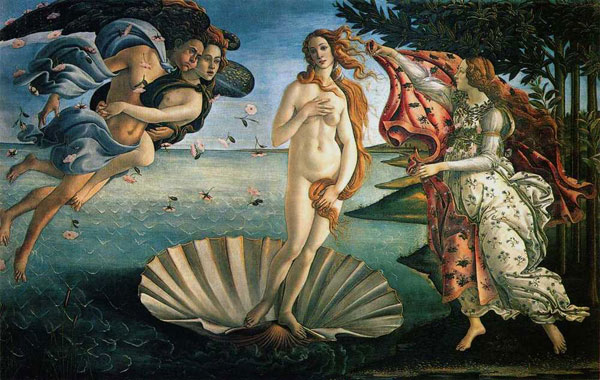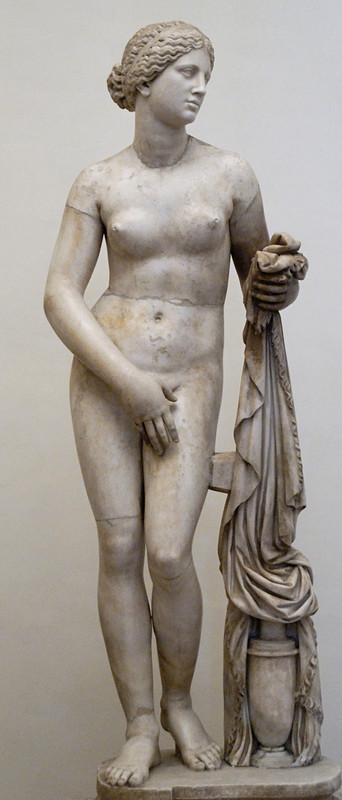
The image above is Aphrodite as depicted in the video game Hades.
♡





 ♡
♡
Aphrodite is the ancient Greek goddess of love, lust, beauty, passion, pleasure, and sexuality; in her syncretised Roman depicition, as Venus, She is likewise the goddess of prosperity and victory. The symbols most traditionally associated with Her include seashells, roses, apples, doves, and swans, though other symbols, such as strawberries (for their association with sex and love) and rabbits (for their tendency to procreate swiftly), are frequently referenced as well. Her ancient Greek worshippers celebrated Her annually with the midsummer Aphrodisia festival, comprised of various rites and sacrifices intended to honor and empower Her—all but one of which demanded no blood be spilt. Interestingly, at the very least from a modern perspective, Aphrodite was once revered as the patron goddess of prostitutes, dawning the intriguing (though historically inaccurate, given the general ancient Greek obsession with chastity) concept of sacred prostitution, or prostitution as divine worship.
Depending upon the myth of reference, the story of Aphrodite's birth can vary; the Homeric tale asserts Her as the daughter of Zeus and the titaness Dione, whereas the Hesiodic depiction states that She came to be after Cronus castrated Uranus and threw his genitals into the sea. These mythological disparities led Plato to proclaim that perhaps these differing origins were the result of two separate goddesses, with two separate births—Aphrodite Urania, born of seafoam, and Aphrodite Pandemos, born of godly copulation—though many modern Hellenists (myself included) consider Urania and Pandemos two facets of the same goddess. In Her Urania epithet, She is "pure," affiliated with non-sexual love; rather, in this form, She is the godddess of pure, chaste love, past physical lust. Quite conversely, in Her Pandemos epithet, Aphrodite is distinctly sensual. As Aphrodite Pandemos, She inspires lust and more "worldly" interactions—in this epithet, she is truly the goddess of passion and pleasure, ruling over human sexuality. These two epithets are not the only that She has taken on throughout history, however; among numerous others, She has also been known as Aphrodite Areia (Her warlike epithet embraced by ancient Laconians; consider the myth of the Trojan War), as well as Cytherea and Cypris (due to mythology claiming Her birth in Cytherea or Cyprus, respectively).
Although Aphrodite was married (by arrangement) to Hephaestus, the god of fire, blacksmithing, and metalworking, She has taken many lovers, both mortal and godly. The most notorious of Her lovers (as well as her second and final husband) is perhaps Ares, the god of war and courage, whom backed Her and the city of Troy against Athena and the city of Athens during the mythological Trojan War (which, in itself, began as a result of Paris of Troy asserting that Aphrodite was the most beautiful goddess of all, above Athena or Hera). As for Her children, She is said to have over ten in total, depending on the source. The most well-known of Aphrodite's children is perhaps Eros (the god of lust), alongside Harmonia (the goddess of harmony), Phobos (the god of fear), Deimos (the god of terror), Aeneas (a demigod hero of the Trojan War), and many others.